A bid is only “too high” compared with the same job. Before comparing totals, make every bid price the same scope, allowances and exclusions. Then check each total against a fair range for your project and area. Use the calculator on this page, or the table below. Our high end sits about 18%–64% above our typical cost, depending on the project. A bid above our high end isn't automatically wrong, but it should come with a clear reason. Estimate
Fair ranges are our blended estimates from each linked guide; the bidding advice draws on the FTC, California's contractor board and HomeGuide[1][2][3].
Fair-bid ranges for common projects Estimate
Here's our national range for twelve reference projects. Adjust for your area with the calculator (it includes all nine Census divisions and our 25 metro areas), then compare. The last column shows how far our high end sits above typical.
| Project | Our range Estimate | Typical Estimate | High vs. typical Estimate |
|---|---|---|---|
| Kitchen remodel, full, same layout (150 sq ft) | $26,300 – $52,500 | $37,500 | 40% |
| Bathroom remodel, full, same layout (40 sq ft) | $17,500 – $41,000 | $25,000 | 64% |
| Tub-to-shower conversion, tiled walk-in | $4,900 – $13,600 | $9,300 | 46% |
| Cabinet refacing (30 linear ft) | $5,000 – $13,100 | $9,000 | 45% |
| Quartz countertops (35 sq ft) | $2,600 – $4,400 | $3,500 | 26% |
| Interior painting, whole house (2,000 sq ft) | $6,000 – $10,500 | $8,500 | 24% |
| Basement finishing, open plan (800 sq ft) | $16,000 – $31,200 | $26,000 | 20% |
| Roof replacement, asphalt (2,000 sq ft) | $8,000 – $19,000 | $12,000 | 58% |
| Vinyl siding (1,250 sq ft of wall) | $7,200 – $15,000 | $10,000 | 50% |
| Window replacement, 10 vinyl windows | $4,300 – $12,300 | $9,000 | 36% |
| Deck, pressure-treated wood (320 sq ft) | $10,900 – $17,300 | $14,400 | 20% |
| Room addition (400 sq ft) | $52,000 – $78,000 | $66,000 | 18% |
Estimate Each range comes from the linked guide, where its sources are cited. Our high end runs 1.5 to 2.9 times our low end, so two honest bids for the same job can be far apart. See How we build our ranges.
How to compare bids, step by step
- Write one scope and give it to everyone. List rooms, materials, fixtures and who buys what. Bids built on different assumptions can't be compared.
- Ask for itemized bids. The FTC advises getting several estimates, each describing the work, materials, completion date and price.[1] A one-line total hides what's missing.
- Line up allowances. If one bid allows $2,000 for tile and another $5,000, the cheaper bid may simply have a smaller allowance. Put every bid on the same allowance before you compare.
- Check the exclusions. Permits, dumpsters, cleanup, drywall patching, painting after electrical work and appliance hookup are the usual gaps.
- Compare each total with a fair range. Use the calculator below with your region or metro.
- Ask about big gaps. The FTC says not to automatically choose the lowest bid and to ask for an explanation when estimates differ a lot.[1]
- Read the payment schedule. The FTC warns against paying the full amount up front and notes some states cap down payments.[1] In California, a down payment can't exceed $1,000 or 10 percent of the contract price, whichever is less.[2] Sourced
What's inside a bid Estimate
A contractor's price covers labor, materials, subcontractors' installed prices, permits and a markup for overhead and profit. HomeGuide puts general contractor fees at 10% to 20% of construction cost[3], and Angi puts a contractor's fee on a bathroom remodel at 10% to 20%.[4] Sourced Here's how our own tub-to-shower line items split:
| Part of the bid | Share Estimate | Amount Estimate |
|---|---|---|
| Labor (our BLS-based lines) | 38% | $2,930 |
| Materials we price | 21% | $1,620 |
| Installed and supplier prices | 25% | $1,930 |
| Permits and fees | 4% | $300 |
| Overhead & profit | 12% | $910 |
| Total | 100% | $7,700 |
Estimate Installed prices (door, niche, grab bar, tub removal) already include each installer's labor and margin. The full line items are below.
Line-item example: a tub-to-shower bid Estimate
This is the build from our tub-to-shower guide. A good bid for the same job should cover each of these lines, even if it groups them differently.
| Line item | How we priced it | Amount Estimate |
|---|---|---|
| Remove the tub and haul it away Installed price | Average of the HomeGuide and Angi tub-removal midpoints[7][8] | $330 |
| Framing and subfloor repairs, blocking for a grab bar and glass door Labor | 6 hrs × $29.12/hr median wage for carpenters[6] × 1.7 labor burden | $300 |
| Plumbing: swap the 1½ in. tub drain for a 2 in. shower drain, new valve Labor | 10 hrs × $30.67/hr median wage for plumbers[6] × 1.7 labor burden | $520 |
| Shower valve, trim, drain and supply parts Materials | Our allowance for a pressure-balanced valve and midrange trim | $450 |
| Pan, waterproofing membrane, backer board, tile and setting materials, about 92 sq ft Materials | Three walls to 7 ft plus the floor at $10/sq ft, our midrange allowance | $920 |
| Build the pan, waterproof and tile Labor | 36 hrs × $26.77/hr median wage for tile and stone setters[6] × 1.7 labor burden | $1,640 |
| Frameless or semi-frameless glass door, installed Installed price | Our blended typical from HomeGuide's and Angi's shower-door ranges[7][8] | $1,050 |
| Recessed niche Installed price | Midpoint of HomeGuide's niche or bench range[7] | $350 |
| Grab bar, installed Installed price | Midpoint of HomeGuide's installed grab-bar range[7] | $200 |
| Drywall patch and paint around the new shower Labor | 6 hrs × $23.75/hr median wage for painters[6] × 1.7 labor burden | $240 |
| Protection and cleanup Labor | 6 hrs × $22.66/hr median wage for construction laborers[6] × 1.7 labor burden | $230 |
| Disposal, protection and sundries Materials | Our allowance | $250 |
| Permit Fee | Our blended typical from HomeGuide's and Angi's permit ranges[7][8] | $300 |
| Overhead & profit Our assumption | 20% on the labor and materials lines above. Installed prices, supplier prices and fees already include the seller's margin, so we don't mark them up again. | $910 |
| Line-item total | Before contingency and regional adjustment | $7,700 |
Estimate Our line-item build comes to $7,700, about 17% below our blended typical of $9,300 for a tiled walk-in conversion. Method: How we build our ranges.
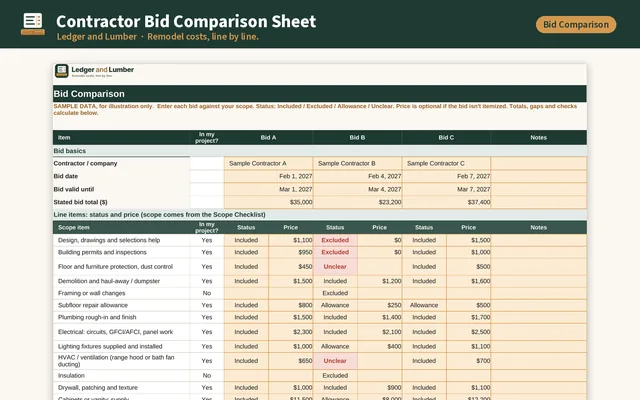
Contractor Bid Comparison Sheet
Put up to three bids on the same rows, with allowances, exclusions and payment terms side by side, so gaps and padding stand out. For Excel and Google Sheets.
Get the templateRed flags in a bid
“You pull the permit”
The FTC lists a contractor asking you to get the required permits as a scam warning sign.[1] Whoever pulls the permit is answerable for the work.
A bid far below the others
A low bid can be a missing line rather than a better price. Check it against the line items above and our fair range before you accept it.
No contingency plan
Ask how the contractor prices surprises: a fixed hourly rate, cost plus a stated markup or a separate change order. Then hold your own reserve. See our contingency guide.
Regional and local differences
A bid that's high in Oklahoma City may be normal in Seattle. The calculator applies our regional index for the project's category: interior, roofing, exterior or additions[5], and for metro areas our local factor, which also reflects local construction wages.[6] Each of our local cost pages lists local trade wages and a local line-item example.
Costs in your city
Our local cost pages adjust these national ranges for 25 metro areas using local construction wages, and add each area's housing age, climate zone and permit office: Atlanta, Birmingham, Boston, Charlotte, Chicago, Columbus, Dallas, Denver, Detroit, Hartford, Houston, Kansas City, Louisville, Minneapolis, Nashville, New York, Oklahoma City, Philadelphia, Phoenix, Portland, Sacramento, Salt Lake City, Seattle, Tampa, Washington. See all local costs →
Contractor bid FAQ
Should I take the lowest bid?
Not automatically. The FTC advises against automatically choosing the lowest bidder and suggests asking for an explanation when estimates differ a lot.[1] Compare scope, allowances and exclusions first; the lowest total is often missing something.
How many bids should I get?
The FTC recommends getting multiple written estimates.[1] Three is a common rule of thumb: enough to see a pattern without wasting contractors' time on a small job.
What is a normal contractor markup?
HomeGuide puts general contractor fees at 10% to 20% of construction cost and says markups on labor and materials range from 8% to 45%.[3] Our own line items use 20% for overhead and profit, our assumption.
How much should I pay up front?
As little as the contract and your state allow. The FTC warns against paying the full amount up front and notes some states limit down payments.[1] California's limit is $1,000 or 10 percent of the contract price, whichever is less.[2] Tie later payments to finished milestones.
What if my bid is above your range?
Ask the contractor to itemize it and compare each line with the matching guide's line-item breakdown. Real reasons include hidden damage, access problems, premium materials, small-job minimums and busy seasons. If none apply, get another bid.
Get the free Remodel Budget Starter
A one-page budget spreadsheet for any project, plus an occasional email when we publish new cost guides or templates. Unsubscribe anytime.
Rather skip the emails? Download the Starter directly.
Related cost guides
Sources
- Federal Trade Commission, Consumer Advice, “How To Avoid a Home Improvement Scam” (July 2022). consumer.ftc.gov/articles/how-avoid-home-improvement-scam (accessed Oct 8, 2026).
- Contractors State License Board (California), Terms of Agreement: A Consumer Guide to Home Improvement Contracts. cslb.ca.gov (accessed Oct 8, 2026). California law; other states differ.
- HomeGuide, “How much do general contractors charge?” (updated Sep 5, 2023). homeguide.com/costs/general-contractor-cost (accessed Oct 8, 2026).
- Angi, “How Much Does a Bathroom Remodel Cost? [2026 Data]” (updated July 9, 2026). angi.com/articles/how-much-does-bathroom-remodel-cost.htm (accessed Oct 8, 2026).
- Zonda / Journal of Light Construction, 2025 Cost vs. Value Report: national averages and regional pages (New England, Middle Atlantic, South Atlantic, East North Central, East South Central, West North Central, West South Central, Mountain, Pacific) (accessed Oct 8, 2026). © 2025 Zonda Media. We quote a few national figures and use the regional figures only to derive our own cost index. States per division from the U.S. Census Bureau, Census Regions and Divisions.
- U.S. Bureau of Labor Statistics, OEWS May 2025 metropolitan, state and national median hourly wages for nine construction trades. bls.gov/oes special requests (accessed Oct 8, 2026). How we use them: metro factors.
- HomeGuide, tub-to-shower conversion cost guide (updated Jul 30, 2025). homeguide.com/costs/tub-to-shower-conversion-cost (accessed Oct 8, 2026).
- Angi, tub-to-shower conversion cost guide (updated Jul 8, 2026). angi.com/articles/convert-tub-to-shower-cost.htm (accessed Oct 8, 2026).
Quoted figures are labeled Sourced. Everything labeled Estimate is our own arithmetic on these sources, explained in How we build our ranges. Planning numbers only, not quotes. Get itemized local bids before you commit.