How the contingency calculator works
- Start from the type of work. The more of the house you open up, the more can go wrong. We start from the middle of our range for the job.
- Add for risk. We add 5% for a home 30 or more years old, and another 5% for known problems such as water, termite or fire damage, or unpermitted work.
- Price it. The suggested percentage times your project cost is the amount to set aside. Project plus contingency is the budget to plan for.
- Work backward from a budget. If you enter your total budget, we divide it by 1 plus the suggested percentage to show the most a bid should be while still keeping the reserve.
Worked example. A $40,000 same-layout bathroom remodel in a 1975 house: our same-layout range is 10%–15%, plus 5% for the home's age, so the middle is 17.5%, or $7,000. Plan for $47,000. With a $50,000 total budget, the most a bid should be is about $42,553.
Our contingency guidance Estimate
| Type of work | Newer home Estimate | Home 30+ years old Estimate |
|---|---|---|
| Cosmetic refresh Paint, flooring, fixtures, counters or cabinet refacing. Walls stay closed. | 5% – 10% | 10% – 15% |
| Same-layout remodel A kitchen or bathroom taken down to the studs, with plumbing and walls staying put. | 10% – 15% | 15% – 20% |
| Layout change, addition or structural work Moving walls, plumbing or gas, adding space or work on the structure. | 15% – 20% | 20% – 25% |
Estimate Our planning guidance. The remodel contingency guide explains the reasoning, the survey data on overruns behind it and what a contingency usually pays for.
Using your contingency well
- Keep it separate. Put it on its own line in your budget so it's not quietly spent on nicer tile.
- Agree on change orders. Ask your contractor to price surprises in writing before the work is done.
- Check the bids first. A contingency covers surprises, not a high bid. Use the quote checker and our guide to comparing contractor bids.
- See if it fits. Our affordability calculator adds your contingency and checks it against your cash and monthly budget.
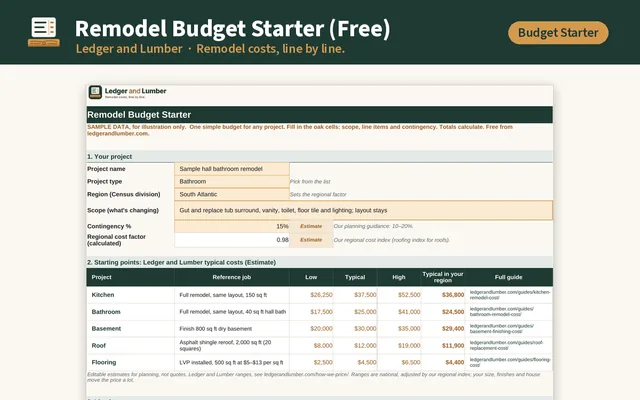
Remodel Budget Starter
A one-page budget with a built-in contingency row. Free, for Excel and Google Sheets.
Get it freeRemodel contingency FAQ
How much contingency should I have for a remodel?
Our guidance is 5%–10% for cosmetic work, 10%–15% for a same-layout remodel and 15%–20% for layout changes, additions and structural work, plus 5% each for an older home or known problems.
Is a 10% contingency enough?
For cosmetic work or a same-layout remodel in a newer home, often yes. For an older home, a layout change or an addition, we'd plan for more.
Should the contingency be in the contractor's bid?
Keep your own reserve either way. Some bids include an allowance or contingency line; ask how unused money is handled and how changes are approved.
What if I don't use the contingency?
Then the project came in on budget. You can put the money toward a deferred upgrade or keep it. Just don't spend it before the risky parts of the job are done.
Is this a guarantee my project won't run over?
No. It's a planning rule of thumb. A detailed scope, itemized bids and written change orders do more to prevent overruns than any percentage.
More free calculators
Estimate Every result on this page is a Ledger and Lumber estimate for planning, not a quote. Ranges are blended from published cost data cited on each cost guide; see How we build our ranges and how we build metro factors. Get itemized local bids before you commit.