That's our recommended contingency for most remodels: about 10% for a same-layout remodel of a newer home, 15% for a typical kitchen or bath, and 20% for older homes, layout changes and additions. Cosmetic jobs need less. Hold it as a separate line in your budget, and don't spend it on upgrades.
Estimate Our guidance, informed by the sources below[1][2][3]. It's a planning choice, not a published standard.
How much contingency by project and home Estimate
A contingency is money set aside for costs you can't see yet: damage behind walls, code upgrades that come with a permit, and price changes. The right amount depends mostly on how much of the house you open up and how old it is.
| Scope | Home under 30 years Estimate | Home 30+ years or known problems Estimate |
|---|---|---|
| Cosmetic refresh Paint, flooring, fixtures, counters or cabinet refacing. Walls stay closed. | 5% – 10% | 10% – 15% |
| Same-layout remodel A kitchen or bathroom taken down to the studs, with plumbing and walls staying put. | 10% – 15% | 15% – 20% |
| Layout change, addition or structural work Moving walls, plumbing or gas, adding space or work on the structure. | 15% – 20% | 20% – 25% |
Estimate Our guidance. Each risk factor (a home 30 or more years old; known water, termite or fire damage or unpermitted work) adds about 5 points; the calculator lets you combine them. We use 30 years as the line because federal 203(k) renovation loans do (below).[2]
What the sources say Sourced
In the 2026 Houzz & Home study, 37% of homeowners who renovated in 2025 went over their budget, 35% came in on budget and 3% came in under; 25% started without a budget at all.[1] FHA's Standard 203(k) renovation loans require a contingency reserve of 10% to 20% of repair costs on homes 30 years or older (at least 15% when utilities aren't working), and on newer homes when there's termite damage; otherwise a reserve of up to 20% is optional.[2] Angi's home addition guide suggests planning for overruns of 5% to 20%.[3]
Why remodels go over budget
Among Houzz respondents who exceeded their budget, the most common reasons were:[1] Sourced
- Products or services cost more than expected: 52%
- Chose more expensive products or materials than planned: 35%
- The project was more complex than expected: 32%
- Changed the project scope or design: 31%
- Discovered unexpected construction-related issues: 22%
Respondents could pick more than one. Only some of these are true surprises. Choosing pricier materials and changing the design are decisions, and they're better handled with realistic allowances up front than with the contingency. Price increases and complexity are what a contingency is for, along with the damage you find when walls come open.
Line-item example: what a contingency pays for Estimate
Here's what a few common surprises would cost on our reference full bathroom remodel, priced with the same method as our guides. Not every job hits all of them, and some hit worse ones. The point is scale: two or three ordinary discoveries can use up a 15% reserve.
| Line item | How we priced it | Amount Estimate |
|---|---|---|
| Rotted subfloor under the old tub: cut out and replace about 20 sq ft Labor | 8 hrs × $29.12/hr median wage for carpenters[5] × 1.7 labor burden | $400 |
| Plywood, joist sistering lumber and fasteners Materials | Our allowance | $180 |
| Corroded galvanized supply lines found when walls open: replace to the bath Labor | 8 hrs × $30.67/hr median wage for plumbers[5] × 1.7 labor burden | $420 |
| PEX, fittings and valves Materials | Our allowance | $220 |
| Add a dedicated 20-amp GFCI circuit the old wiring lacks Labor | 6 hrs × $30.38/hr median wage for electricians[5] × 1.7 labor burden | $310 |
| Wire, breaker, box and device Materials | Our allowance | $120 |
| Upgrade from $10 to $15 per sq ft tile allowance on about 140 sq ft Materials | Our allowance; Houzz's top reasons for overruns include choosing pricier materials | $700 |
| Overhead & profit Our assumption | 20% on the labor and materials lines above. Installed prices, supplier prices and fees already include the seller's margin, so we don't mark them up again. | $470 |
| Line-item total | Before contingency and regional adjustment | $2,800 |
Estimate Our line-item build comes to $2,800, about 25% below our blended typical of $3,750 for a 15% contingency on our typical full bathroom remodel ($25,000). The tile upgrade is a choice, not a surprise. It's included to show how quickly upgrades eat a reserve meant for damage. Method: How we build our ranges.
Remodel Budget Starter
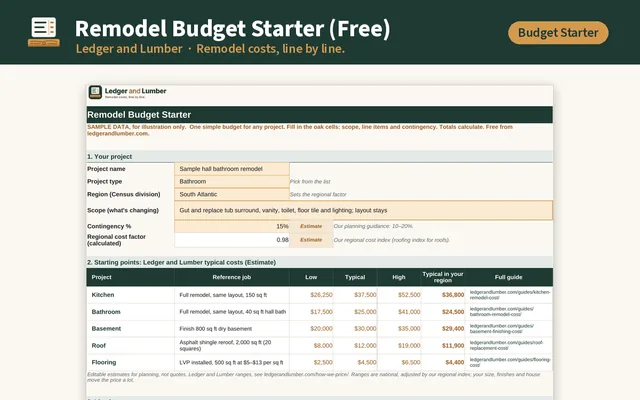
Our free one-page budget sheet has a contingency row built in. Set your percentage, track what you draw from it, and see what's left before you approve upgrades.
Get it freeHow to use a contingency well
Keep it separate
Put the contingency on its own line in your budget and in your financing, not inside the contractor's price. Then you decide when it's spent.
Draw on it only by change order
When something unexpected comes up, get a written change order with a price before work proceeds. California requires price changes to be made in writing[4], and it's good practice everywhere.
Fix allowances first
Low allowances for tile, fixtures or appliances are the most common way a budget “runs over” without any surprise at all. Price your real selections before signing.
Inspect before you sign
On older homes, a pre-remodel inspection of plumbing, wiring and the area under the tub or sink can turn unknowns into line items, which is cheaper than finding them mid-job.
Spend what's left at the end
If the reserve survives until the last phase, that's the time for upgrades, not the first week.
Regional note: housing age by metro
Where you live affects contingency less through prices than through the age of the houses. These are the six oldest and six newest housing markets among our local cost pages, using Census data.[6] Older housing means more homes past the 30-year mark and more chances of old wiring, galvanized pipes and lead paint.
| Metro | Median year built Sourced | Built before 1980 Sourced |
|---|---|---|
| New York, NY | 1961 | 72% |
| Boston, MA | 1965 | 65% |
| Philadelphia, PA | 1966 | 65% |
| Hartford, CT | 1968 | 68% |
| Detroit, MI | 1968 | 66% |
| Chicago, IL | 1972 | 61% |
| Phoenix, AZ | 1995 | 26% |
| Atlanta, GA | 1996 | 25% |
| Nashville, TN | 1996 | 30% |
| Dallas, TX | 1996 | 28% |
| Houston, TX | 1997 | 29% |
| Charlotte, NC | 1998 | 28% |
Estimate One thing stands out: in 23 of our 25 metros the median home is now 30 or more years old, and even in the newest market (Charlotte, NC, median 1998) it's 28. So for the typical home almost anywhere, the 30+ column above applies or soon will: about 15% – 20% for a same-layout remodel. The gap between metros shows up in the share of truly old housing, where lead paint and decades of earlier repairs are more likely. Check your own home's year built before choosing a number.
Median year built and pre-1980 share: U.S. Census Bureau, American Community Survey 2024 1-year estimates (tables B25035 and B25034).[6] Suggested contingency is our guidance from the table above, applied to the typical home in each metro; your own home's age matters more.
Costs in your city
Our local cost pages adjust these national ranges for 25 metro areas using local construction wages, and add each area's housing age, climate zone and permit office: Atlanta, Birmingham, Boston, Charlotte, Chicago, Columbus, Dallas, Denver, Detroit, Hartford, Houston, Kansas City, Louisville, Minneapolis, Nashville, New York, Oklahoma City, Philadelphia, Phoenix, Portland, Sacramento, Salt Lake City, Seattle, Tampa, Washington. See all local costs →
Remodel contingency FAQ
What percentage should I set aside for contingency?
Our guidance is 10% to 20% for most remodels: about 10% for a same-layout remodel of a newer home, 15% for a typical kitchen or bath, 20% for older homes, layout changes and additions, and 5% to 10% for cosmetic work.
Is 10% contingency enough?
For a newer home and a project that doesn't open walls, often yes. FHA requires at least 10% on 203(k) renovation loans for homes 30 years or older, and allows up to 20%.[2]
How often do remodels go over budget?
In the Houzz study, 37% of homeowners who renovated in 2025 exceeded their budget, compared with 35% on budget and 3% under.[1]
Is contingency the same as an allowance?
No. An allowance is a placeholder price for something you haven't picked yet, like tile or a faucet. A contingency covers things nobody can see yet, like damage behind a wall. Low allowances cause overruns too, so set them realistically.
Does my contractor include contingency in the bid?
Sometimes, sometimes not. Ask. If it's inside the bid, ask how it's tracked and whether unused money comes back to you. Our preference is to hold your own reserve and pay for surprises by written change order.
Get the free Remodel Budget Starter
A one-page budget spreadsheet for any project, plus an occasional email when we publish new cost guides or templates. Unsubscribe anytime.
Rather skip the emails? Download the Starter directly.
Related cost guides
Sources
- Houzz Inc., 2026 U.S. Houzz & Home Renovation Trends Study (2026), covering projects in 2025. houzz.com research PDF (accessed Oct 8, 2026).
- U.S. Department of Housing and Urban Development, FHA Single Family Housing Policy Handbook 4000.1, version issued Jan 10, 2025, Standard and Limited 203(k) contingency reserves. archives.hud.gov (accessed Oct 8, 2026).
- Angi, “How Much Does a Home Addition Cost? [2026 Data]” (updated May 30, 2026). angi.com/articles/how-much-do-home-additions-cost.htm (accessed Oct 8, 2026).
- Contractors State License Board (California), Terms of Agreement: A Consumer Guide to Home Improvement Contracts. cslb.ca.gov (accessed Oct 8, 2026).
- U.S. Bureau of Labor Statistics, Occupational Employment and Wage Statistics (OEWS), May 2025 national median hourly wages by occupation, retrieved through the BLS Public Data API. bls.gov/oes (accessed Oct 8, 2026).
- U.S. Census Bureau, American Community Survey 2024 1-year estimates, tables B25035 (median year built), B25034 (year built), B25077 (median value) and B25003 (tenure), metro areas, retrieved through the Census Reporter API (accessed Oct 8, 2026).
Quoted figures are labeled Sourced. Everything labeled Estimate is our own arithmetic on these sources, explained in How we build our ranges. Planning numbers only, not quotes. Get itemized local bids before you commit.